
01
1. Importance of Vegetable Cutting in Food Preparation
Vegetable cutting is one of the most time-consuming tasks in commercial kitchens and food processing units. Manual cutting requires significant labor and often leads to inconsistent sizes. Businesses use a vegetable cutting machine to improve efficiency, consistency, and hygiene.
02
2. What is a Vegetable Cutting Machine?
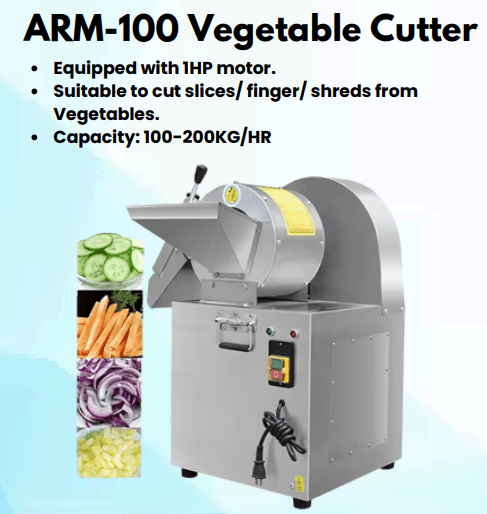
A vegetable cutting machine is a food processing device designed to cut vegetables into slices, cubes, strips, shreds, or dices. It helps restaurants, hotels, caterers, and food manufacturers process large quantities of vegetables quickly and accurately.
03
3. Types of Vegetable Cutting Machines
Vegetable cutting machines are available in manual, semi-automatic, and fully automatic models. Depending on the application, businesses may choose slicers, dicing machines, shredders, or multifunctional cutters capable of handling multiple cutting styles.
04
4. Production Capacity
Machines are available in capacities ranging from 50 kg per hour for small restaurants to over 2000 kg per hour for industrial food processing plants. Capacity selection depends on daily production requirements.
05
5. Applications
Vegetable cutting machines are widely used in restaurants, hotels, catering services, cloud kitchens, central kitchens, food processing units, frozen food manufacturers, and institutional canteens.
06
6. Vegetable Cutting Machine Price
The price of a vegetable cutting machine typically starts from ₹25,000 for basic commercial models and can exceed ₹5 lakh for high-capacity automatic industrial machines with multiple cutting functions.
07
7. Features to Consider
When choosing a machine, look for stainless steel construction, interchangeable cutting blades, safety protection systems, easy cleaning, energy efficiency, and the ability to process different vegetables without damage.
08
8. Benefits
Vegetable cutting machines significantly reduce labor costs, improve cutting consistency, increase productivity, minimize food wastage, and maintain higher hygiene standards compared to manual processing.
09
9. Choosing the Right Supplier
Select a trusted manufacturer that offers quality machines, after-sales service, spare parts availability, and technical support. A reliable supplier ensures long-term performance and lower maintenance costs.